
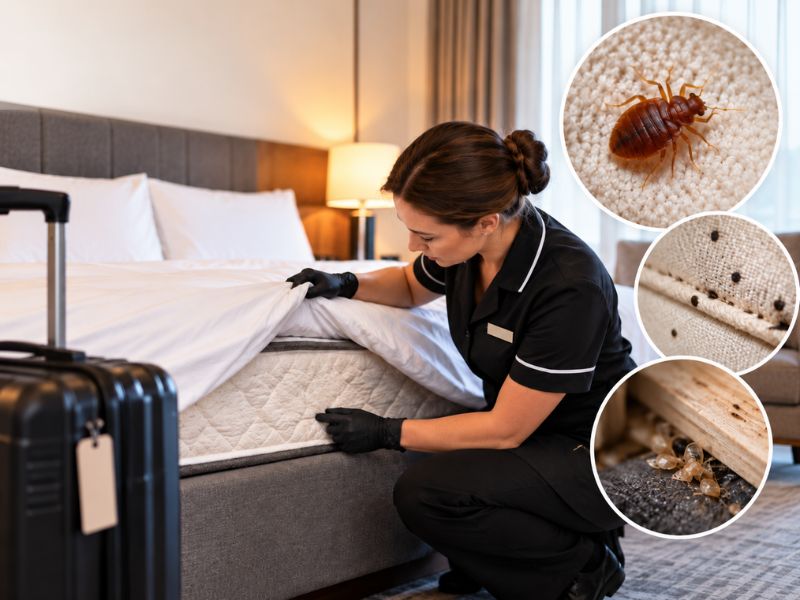
A guest approaches reception and reports finding bed bugs in their hotel room. What happens next? For hotel managers, housekeeping supervisors and front-of-house teams, a suspected bed bug infestation requires a prompt, organised and professional response. Although bed bugs can affect hotels of any standard, the way staff handle a complaint can make a significant difference to guest confidence, operational disruption and the risk of an infestation spreading. Knowing when to remove a room from service, how to record evidence, what to tell guests and when to arrange professional bed bug extermination helps hotels respond appropriately.
This practical guide explains what hotel staff should do when a guest reports bed bugs, from the initial conversation through to inspection, treatment and returning a room to service.
1. Take Every Bed Bug Complaint Seriously
The first priority is to listen to the guest and acknowledge their concerns.
Discovering suspected bed bugs can be distressing, particularly when a guest has experienced bites or worries about carrying insects home in their luggage.
Hotel staff should:
- Remain calm, professional and discreet.
- Thank the guest for bringing the concern to their attention.
- Avoid dismissing the complaint or suggesting that poor hygiene is responsible.
- Notify the duty manager or designated member of the management team.
- Explain that the hotel will investigate the report promptly.
- Offer appropriate assistance, including alternative accommodation where necessary.
Staff should avoid confirming that bed bugs are present before an inspection has taken place.
Important: Bed bugs are not an indication that a hotel is dirty. They can enter even the most carefully maintained accommodation through luggage, clothing and other personal belongings.
How a hotel responds to the initial complaint is often just as important to the guest as the subsequent investigation.
2. Record the Incident and Preserve Evidence
Accurate incident recording should form part of every hotel’s pest management procedures.
As soon as a complaint is received, staff should create an incident record containing relevant details.
| Information | What Staff Should Record |
|---|---|
| Date and time | When the complaint was received |
| Room details | Room number, floor and relevant booking information |
| Guest report | What the guest observed, including any reported bites or insect sightings |
| Evidence | Photographs, insect sightings or physical evidence, where available |
| Staff response | Who received the complaint and who was notified |
| Immediate action | Room closure, guest relocation and precautions taken |
| Professional support | Pest control appointment and inspection findings |
| Follow-up | Treatment, monitoring and room reopening decision |
Where possible, photographs of suspected insects or signs of activity can help the pest control technician assess the situation.
If a suspected insect can be collected safely, an appropriate sealed specimen container may assist identification.
However, staff should not disturb furniture unnecessarily or carry out extensive investigations without suitable training.
A well-maintained incident record helps management identify recurring problems, coordinate treatment and demonstrate how the hotel responded.
3. Remove the Suspected Room from Service
When a guest reports suspected bed bugs, the safest operational approach is generally to remove the affected room from sale until a suitable inspection has taken place.
Do not simply change the bedding, vacuum the carpet and allocate the room to another guest.
Bed bugs are particularly difficult to detect because they conceal themselves in small gaps and crevices, including:
- Mattress seams and bed bases
- Headboards and bed frames
- Bedside furniture and drawer joints
- Upholstered chairs and sofas
- Skirting boards and flooring edges
- Curtain folds and surrounding fixtures
- Luggage racks and storage areas
A room can appear completely clean while still harbouring bed bugs.
Housekeeping and reception teams should receive clear instructions that the room is temporarily unavailable.
Staff should also avoid moving potentially affected mattresses, furniture or loose bedding through other areas of the hotel.
The aim is to preserve evidence, limit potential spread and allow a professional inspection to establish whether treatment is necessary.
4. Consider the Surrounding Hotel Rooms
One of the most important considerations in hotel bed bug management is whether the problem extends beyond the room where the guest made the complaint.
Bed bugs can move between rooms through gaps and structural openings, as well as being transported on luggage, bedding and other items.
Where activity is suspected or confirmed, hotel management should arrange for the pest control professional to assess whether additional rooms require inspection.
This may include:
- Rooms directly next door
- Rooms above and below
- Rooms connected by internal doors
- Relevant adjoining areas or furniture storage locations
Not every neighbouring room will automatically require treatment. The inspection findings should determine the extent of the problem and the appropriate action.
For hotels managing multiple floors or large numbers of bedrooms, a structured bed bug management programme can help identify patterns and establish consistent inspection procedures.
A single complaint should never automatically be treated as an isolated incident without considering the possibility of wider activity.
5. Communicate Clearly with the Guest
Good guest communication is essential when dealing with suspected bed bugs.
The guest may be concerned about their health, personal belongings, upcoming travel arrangements or the possibility of carrying bed bugs home.
A member of the management team should explain what the hotel is doing and provide an appropriate point of contact.
This may include:
Offering an alternative room
Where possible, offer a room away from the suspected affected area, rather than immediately relocating the guest next door. The replacement room should be checked before use.
Explaining the investigation
Inform the guest that the hotel is arranging an appropriate inspection and that any treatment decisions will depend on the findings.
Providing practical luggage advice
Explain that bed bugs can travel in personal belongings. Recommend keeping luggage closed and away from beds or upholstered furniture until suitable precautions have been discussed.
Discussing guest welfare
Where guests report bites or discomfort, acknowledge their concerns and direct them towards appropriate medical advice if necessary.
Recording any agreed resolution
Document room changes, refunds, alternative accommodation or other arrangements in accordance with the hotel’s complaints procedure.
Avoid making promises that an infestation has been eradicated before professional checks have been completed.
Maintaining discreet, respectful communication protects the guest’s privacy and helps preserve trust.
6. Brief Housekeeping Staff on What Not to Do
Housekeeping teams play an important role in detecting early signs of bed bugs. However, certain well-intentioned actions can make an infestation more difficult to manage.
When an affected room has been identified, staff should avoid:
- Transferring loose linen or furnishings into another bedroom.
- Using domestic insecticide sprays or fogging products without professional direction.
- Moving potentially infested mattresses into communal storage areas.
- Disposing of furniture without following an agreed containment procedure.
- Moving cleaning equipment between rooms without considering contamination risks.
- Reopening the room simply because no insects are immediately visible.
Any laundry handling should follow an appropriate containment procedure. Where recommended, potentially affected washable items can undergo suitable high-temperature laundering and drying, in line with fabric care requirements.
A professional pest control technician should advise on preparation and handling requirements before treatment begins.
For further information on recognising possible activity, our guide, Hotel Bed Bugs: What to Look For, explains some of the warning signs that hotel teams and guests should recognise.
7. Arrange Professional Bed Bug Extermination
Bed bugs are particularly resilient and can be difficult to eliminate without specialist equipment, knowledge and treatment methods.
They can hide deep within furniture, structural gaps and other areas that routine housekeeping cannot adequately inspect.
Professional bed bug extermination begins with establishing whether an infestation exists, identifying affected areas and assessing its extent.
Depending on the findings, treatment may involve a combination of:
Professional inspection: Examining beds, furniture, surrounding fixtures and other areas where bed bugs may be hiding.
Heat treatment: Using controlled temperatures and specialist equipment to treat affected environments where appropriate.
Targeted insecticide treatment: Applying suitable professional products in accordance with their approved uses and relevant safety precautions.
Monitoring: Using appropriate monitoring methods to assess whether bed bug activity continues.
Follow-up inspections: Reviewing the effectiveness of treatment and establishing whether further action is necessary.
At Pest Control 24 Seven, we provide specialist bed bug control services for hotels and other commercial accommodation providers.
Our approach considers the individual premises, the extent of the infestation and the importance of limiting disruption to hotel operations.
Professional support also provides hotel management with documented findings and recommendations to inform the next steps.
8. When Can a Hotel Room Reopen After Bed Bug Treatment?
A common question from hotel managers is how quickly a room can return to service.
The answer depends on the inspection findings, the level of infestation, the treatment method and whether further monitoring or treatment is needed.
A room should not automatically reopen immediately after treatment.
Before releasing the bedroom for guests, management should confirm that:
- The pest control technician’s relevant instructions have been followed.
- Any required treatment restrictions and re-entry periods have passed.
- Recommended follow-up inspections or monitoring have taken place.
- Outstanding concerns have been addressed.
- The decision to return the room to service has been recorded.
Different treatment methods may require different follow-up arrangements. Some infestations need more than one treatment visit.
The objective is to return the room to use safely and with reasonable confidence that the infestation has been controlled.
You can read more about our approach to bed bug eradication and the importance of monitoring after treatment.
9. Use the Incident to Improve Hotel Bed Bug Prevention
Once the immediate issue has been addressed, hotel management should review the incident and identify opportunities to improve prevention.
Bed bugs can be introduced through normal guest movements, so completely eliminating the possibility of future introductions is unrealistic.
However, hotels can improve early detection and reduce the potential for infestations to become established.
Practical measures include:
Housekeeping awareness training
Ensure staff recognise evidence such as live insects, shed skins, dark spotting and blood marks on bedding.
Clear reporting procedures
Give employees a straightforward process for reporting potential pest activity to management.
Routine bedroom checks
Incorporate appropriate visual checks of mattresses, bed frames and upholstered furnishings into housekeeping and maintenance procedures.
Bed bug incident records
Maintain a central record so managers can identify repeat reports or activity affecting particular areas.
Professional monitoring
Arrange additional inspections or monitoring where the property’s risk assessment indicates they would be beneficial.
Ongoing pest management
Develop an agreed response procedure with a professional pest control provider rather than waiting until an infestation becomes widespread.
Our bed bug pest control services support businesses in managing pest activity and maintaining appropriate control measures.
10. Why a Hotel’s Response Matters Just as Much as the Infestation
For hotels, the consequences of a poorly managed bed bug complaint can extend beyond the cost of treatment.
Potential impacts include lost room revenue, dissatisfied guests, negative online reviews, operational disruption and damage to the hotel’s reputation.
A delayed or inconsistent response can also increase the risk of bed bugs spreading before the problem is properly investigated.
By contrast, a hotel with established procedures can respond promptly, coordinate staff responsibilities and ensure guests receive clear information.
The most effective approach brings together housekeeping, front-of-house staff, management and professional pest control support.
Bed bug prevention is not simply about keeping rooms clean. It is about identifying problems early, responding consistently and knowing when specialist intervention is required.
Frequently Asked Questions About Hotel Bed Bugs and Bed Bug Extermination
1. What should hotel reception staff do if a guest reports bed bugs?
Reception staff should take the complaint seriously, record the relevant details and notify the duty manager immediately. The hotel should consider removing the suspected room from service, offer suitable alternative accommodation and arrange an appropriate inspection.
Staff should avoid dismissing the guest’s concerns or confirming an infestation without evidence.
2. Should a hotel close a room if a guest reports bed bug bites?
A suspected room should generally be taken out of service while the complaint is investigated. However, bites alone do not prove that bed bugs are present, as other insects and skin conditions can produce similar reactions.
A professional inspection can help establish whether bed bug activity exists and whether treatment is required.
3. Do hotels need to inspect neighbouring rooms after finding bed bugs?
Yes, neighbouring rooms should be considered as part of the professional risk assessment. This may include bedrooms immediately beside, above or below the affected room.
The pest control specialist should determine which rooms require inspection and whether any additional treatment is necessary.
4. Can housekeeping staff remove bed bugs through normal cleaning?
Normal housekeeping can help staff identify signs of bed bugs, but it is unlikely to eliminate an established infestation.
Bed bugs can hide in locations that routine cleaning does not reach. Professional bed bug extermination may require specialist inspection, heat treatment, targeted insecticides and follow-up monitoring.
5. How quickly can a hotel reopen a room after bed bug extermination?
There is no universal reopening time. It depends on the treatment method, infestation severity, product safety instructions and inspection findings.
Hotel management should follow the pest control technician’s recommendations and document the decision before returning the room to service.
6. How can hotels reduce the risk of future bed bug infestations?
Hotels should introduce staff awareness training, routine visual checks, clear incident-reporting procedures and professional monitoring where appropriate.
Although hotels cannot prevent every introduction of bed bugs, a proactive management programme can help identify activity earlier and reduce the risk of a larger infestation developing.
Professional Bed Bug Extermination for Hotels – Pest Control 24 Seven
When a guest reports bed bugs, your hotel’s response needs to protect guest welfare, minimise disruption and address the possibility of an infestation spreading.
Pest Control 24 Seven provides professional bed bug inspections, treatment and management support for hotels, hospitality businesses and other commercial accommodation providers.
We understand the importance of discreet service delivery, clear communication and practical solutions that work around the operational requirements of busy hospitality environments.
Whether you are responding to a suspected infestation or reviewing your hotel’s preventative pest management procedures, our team can provide advice and specialist support.
Call our Operations Team: 0203 640 8247
Website: www.pestcontrol24seven.co.uk