
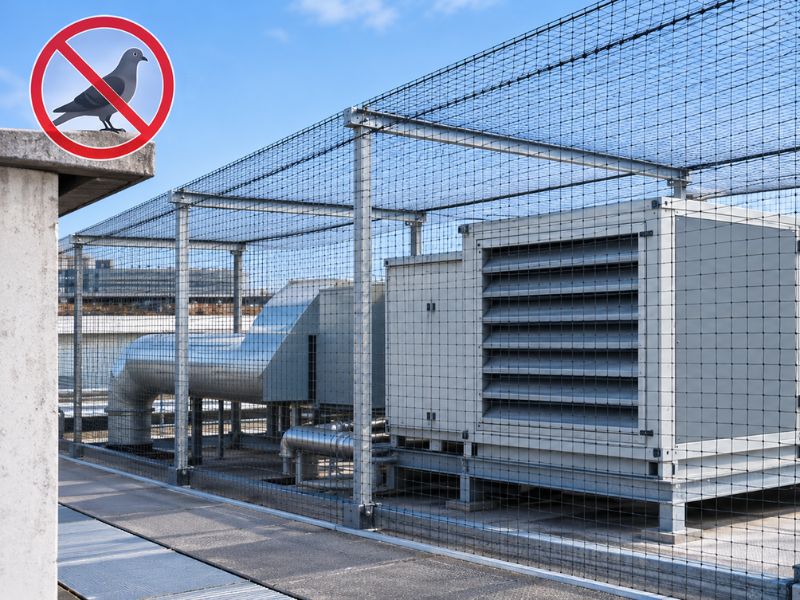
Facilities managers often overlook rooftop plant areas when assessing bird activity on commercial and industrial buildings. However, these spaces attract pigeons and other birds looking for sheltered places to perch, roost or nest. Industrial bird netting provides an effective way to protect vulnerable rooftop equipment and prevent recurring bird problems.
Air-handling units, ventilation ductwork, extraction fans and associated pipework create numerous sheltered spaces. Over time, birds can contaminate equipment, increase maintenance requirements and cause costly operational problems.
For facilities managers and maintenance teams, simply removing birds does not solve the problem. They need to stop birds returning while keeping essential equipment running efficiently.
Professionally designed industrial bird netting can provide a long-term solution, protecting rooftop machinery while allowing engineers to carry out inspections, servicing and repairs.
Quick Answer: Can Industrial Bird Netting Protect Rooftop HVAC Equipment?
Yes. Industrial bird netting creates a physical barrier that prevents birds from accessing selected areas around rooftop HVAC equipment, ventilation systems and machinery.
A correctly designed and installed system helps prevent nesting, reduces bird droppings and protects equipment from avoidable contamination.
However, installers must maintain essential airflow, provide suitable access for engineers and ensure the netting does not interfere with mechanical equipment.
A professional assessment of the bird activity and rooftop plant layout helps identify the most effective solution.
Why Do Birds Nest Around Rooftop Plant Equipment?
Rooftop plant installations often create ideal conditions for birds.
Although rooftops face constant exposure to the elements, mechanical equipment provides sheltered spaces that birds cannot find on an open roof.
Common attractions include:
- Air-handling units (AHUs): Equipment housings and surrounding structures provide sheltered perching locations.
- External ductwork: Horizontal surfaces, supports and junctions offer convenient roosting points.
- Ventilation fans: Surrounding steelwork and equipment enclosures create protected spaces.
- Pipework and cable trays: These provide elevated landing positions and potential nesting locations.
- Plant screens and structural frames: Enclosed or partially covered areas shelter birds from wind and rain.
Once pigeons establish a regular roosting location, they often return to the same area.
Cleaning affected surfaces removes the immediate contamination but does not address why birds continue using the location.
Industrial bird netting tackles this problem by physically preventing birds from accessing established roosting and nesting areas.
How Can Bird Activity Affect HVAC Equipment?
Bird activity around rooftop plant can create problems beyond the visible accumulation of droppings.
1 Contamination Around Air Intakes and Ventilation Equipment
Birds leave droppings, feathers and nesting materials around ventilation equipment and external air intakes.
If debris enters or obstructs vulnerable components, it may affect equipment performance and increase cleaning requirements.
Facilities managers should investigate bird contamination near air-handling equipment, particularly where ventilation systems supply air to occupied areas.
Industrial bird netting helps prevent birds from settling in vulnerable locations, reducing opportunities for further contamination.
2 Blocked Drainage and Water Damage
Birds frequently leave nesting materials and debris in rooftop drainage channels, gutters and around plant equipment.
When debris blocks drainage routes, water can collect around equipment bases and vulnerable areas of the roof.
Over time, this may contribute to maintenance problems, water ingress and deterioration of building materials.
By preventing birds from accessing established nesting areas, industrial bird netting can help reduce recurring debris accumulation.
3 Increased Maintenance and Cleaning Costs
Bird fouling creates additional work for building maintenance teams.
Facilities managers may need to arrange specialist cleaning before engineers can safely inspect or service contaminated equipment.
When birds continue returning, businesses may face repeated contractor visits, additional access costs and disruption to planned maintenance schedules.
Although industrial bird netting requires an initial investment, effective bird exclusion can reduce the need for repeated reactive cleaning.
4 Difficult or Unsafe Working Conditions
Engineers need safe access to rooftop HVAC equipment for routine inspections, servicing and emergency repairs.
Heavy bird fouling creates hygiene concerns, while accumulated nesting materials can obstruct inspection points and maintenance routes.
Wet bird droppings can also create slip hazards.
Preventing recurring bird activity helps facilities managers maintain cleaner, safer and more accessible rooftop plant areas.
Where Can Industrial Bird Netting Be Installed Around Rooftop Plant?
Installers do not always need to position industrial bird netting directly over HVAC equipment.
Instead, they can design the system around existing machinery, structural features and areas where birds regularly settle.
Suitable locations may include:
- Structural frameworks surrounding rooftop plant
- Sheltered spaces beneath elevated ductwork
- Roof plant enclosures and screening structures
- Gaps between adjacent equipment installations
- Steel supports and overhead structures
- Recessed spaces where birds regularly roost or nest
The positioning of the netting plays an important role in its effectiveness.
Poorly planned installations can restrict airflow, obstruct access to equipment components or make routine maintenance unnecessarily difficult.
Before installing the netting, contractors should identify ventilation openings, fans, access doors and removable components to ensure the system does not interfere with essential operations.
Learn more about our industrial bird netting services for commercial and industrial buildings.
Can Bird Netting Restrict HVAC Maintenance Access?
Yes, particularly when installers overlook maintenance requirements during the design stage.
Rooftop plant equipment needs regular attention, including filter replacement, fan inspections, motor servicing, cleaning, testing and occasional component replacement.
Engineers must also reach equipment quickly when faults occur.
If installers position a fixed barrier across an access route, they can turn straightforward maintenance into a complicated and potentially costly task.
Industrial bird netting should keep birds out without preventing engineers from doing their jobs.
Depending on the layout, installers can incorporate:
- Zipped openings for routine access
- Removable netting sections
- Suitable clips and secure access points
- Designated routes to equipment and inspection locations
These features allow maintenance teams to reach protected areas without cutting through or damaging the netting.
After completing their work, engineers should secure all access openings to maintain the effectiveness of the bird exclusion system.
Facilities managers should consult their HVAC maintenance contractors before approving an industrial bird netting installation.
For further information, read our guide to bird netting with zip access.
How to Plan Industrial Bird Netting Around Rooftop Machinery
An effective industrial bird netting installation involves more than measuring an area and fitting a mesh barrier.
Contractors must consider the building’s mechanical systems, maintenance requirements and existing bird activity.
1 Identify Where Birds Are Causing Problems
Start by identifying where birds land, roost or nest.
Look for droppings, feathers, nesting materials and repeated activity around specific equipment.
A professional bird control survey can identify vulnerable areas and determine whether netting offers the most suitable solution.
2 Review the HVAC Equipment Layout
Identify all equipment within the area that needs protection.
Pay particular attention to air intakes, exhaust outlets, access panels, fans, motors, electrical equipment and removable components.
Make sure the proposed netting does not obstruct ventilation openings or interfere with equipment operation.
3 Establish Maintenance Access Requirements
Speak to maintenance contractors about the equipment they regularly inspect and service.
Consider routine maintenance, emergency repairs and the space engineers need to remove or replace components.
Planning access requirements before installation helps avoid expensive alterations later.
4 Assess Safe Installation Methods
Rooftop plant often occupies difficult-to-reach locations or sits within complex structural steelwork.
Contractors must assess working-at-height risks, suitable anchorage or access arrangements and the building’s operational requirements.
They should also consider wind exposure, structural fixing points and the condition of supporting surfaces.
5 Arrange Ongoing Inspections
Facilities managers should include industrial bird netting within their planned inspection schedules.
Regular checks help confirm that the mesh, supporting fixings, perimeter seals and maintenance access points remain secure and effective.
Arrange additional inspections following severe weather or building maintenance that may have disturbed the installation.
Why Industrial Bird Netting Should Form Part of Planned Building Maintenance
Many businesses only address bird problems once contamination becomes noticeable.
They arrange cleaning, remove the immediate problem and return to normal operations.
However, birds often return to the same rooftop structures, creating another cycle of contamination and cleaning.
For facilities managers responsible for several properties, these repeated callouts can increase maintenance costs and consume valuable time.
Including bird protection within planned building maintenance allows teams to identify recurring problems before they escalate.
This might involve:
- Checking for bird activity during routine roof inspections
- Identifying vulnerable equipment during HVAC servicing
- Reviewing existing bird protection when upgrading rooftop plant
- Assessing recurring contamination around air intakes and external ductwork
- Planning preventative bird control alongside other rooftop maintenance
Industrial bird netting can support this approach by providing long-term protection where birds repeatedly access defined areas.
However, not every rooftop requires extensive netting. Smaller ledges and individual perching locations may benefit from alternative deterrent systems.
The best solution depends on the bird species, building layout and extent of the problem.
Explore our wider bird proofing services to learn more about the available options.
What About Birds Already Nesting Around Rooftop Equipment?
Wildlife legislation plays an important role in planning bird control work.
In Great Britain, the Wildlife and Countryside Act 1981 protects wild birds and their nests, with additional protections applying to certain species and circumstances.
The law generally prohibits damaging or destroying nests while birds are building or using them.
If contractors discover nesting activity around rooftop equipment, they must assess the situation before installing netting or removing nesting materials.
They may need to postpone or adapt the installation to avoid disturbing protected birds and nests unlawfully.
Contractors must also ensure that the netting does not trap birds within or behind the protected area.
A professional assessment helps establish the appropriate approach before work begins.
Common Questions About Industrial Bird Netting for Rooftop Plant
Can industrial bird netting be installed around air-handling units?
Yes. Industrial bird netting can protect selected areas surrounding air-handling units. However, installers must maintain airflow, service clearances and access to essential components. They should also check the equipment manufacturer’s requirements before finalising the design.
Will bird netting affect the performance of HVAC equipment?
A properly designed system should not interfere with HVAC operations. However, netting positioned too close to ventilation intakes, outlets or moving equipment may create problems. HVAC specialists should review the proposed arrangement before installation.
Can industrial bird netting be installed on an operational building?
In many cases, yes. Contractors can plan installation work around normal building activities, provided they can maintain safe access and meet the equipment’s operating requirements. Some installations may require temporary isolation or restricted access.
Is bird netting suitable for external ductwork?
Yes. Industrial bird netting can protect spaces around external ductwork where birds regularly perch or nest. Installers must ensure that maintenance teams can continue inspecting, cleaning and repairing the ductwork.
How often should rooftop bird netting be inspected?
Inspection frequency depends on the installation, environmental exposure and site conditions. Facilities managers should include checks within planned building maintenance and arrange additional inspections following severe weather, equipment replacement or work that may have disturbed the netting.
Can industrial bird netting reduce HVAC maintenance costs?
Yes, it may help reduce costs associated with recurring bird contamination, specialist cleaning and repeated contractor visits. However, actual savings depend on the extent of the original problem, installation costs and ongoing maintenance requirements.
Protect Your Rooftop Plant with Pest Control 24 Seven
Rooftop HVAC equipment plays an essential role in keeping buildings operational, but surrounding structures often attract birds looking for somewhere to perch or nest.
Without effective prevention, recurring bird activity can increase cleaning requirements, create hygiene concerns and complicate essential maintenance work.
At Pest Control 24 Seven, we provide professional bird control solutions for commercial and industrial buildings, including industrial bird netting that accommodates existing equipment and maintenance access requirements.
Whether pigeons are nesting around your rooftop plant, contaminating ventilation equipment or repeatedly roosting beneath external ductwork, our team can assess the problem and recommend a suitable solution.
Find out more about our industrial bird netting services or contact Pest Control 24 Seven to discuss your requirements and arrange a site assessment.